


metanoia
A New Way of Seeing


_edited.png)
As part of the SEAMEO SEA Teachers’ Programme Batch 11 calendar of activities, my class observation and assistantship formally commenced from April 8–17, 2026. During this period, I was immersed in the science classes of Madrasah Aliyah Negeri 1 Kota Kendari (MAN 1 Kota Kendari), where I was assigned under the mentorship of two cooperating teachers: Mr. Rahmat Fortuna Rasak, S.Pd. (main teacher) and Mrs. Rizka Rahmawati, S.Pd., M.Pd. (supporting teacher). The co-teaching arrangement immediately stood out as a defining feature of instruction in this context, where teaching responsibilities are strategically distributed to effectively facilitate differentiated instruction and classroom management.
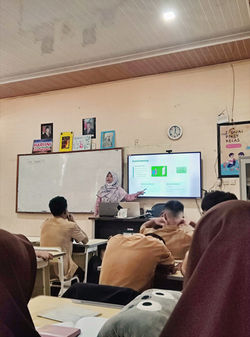
At the outset of my observation, I initially assumed that a single cooperating teacher would handle the class. However, I later observed that MAN 1 employs a co-teaching model or what they termed hybrid teaching in selected subjects, particularly Science, Mathematics, and English. Mr. Rahmat typically assumes the role of lead instructor, delivering core concepts and facilitating class discourse, while Mrs. Rizka provides targeted scaffolding, circulating the room to assist learners who require either remediation or enrichment. This dual-teacher setup established a responsive learning environment, guaranteeing that no learner is left behind—especially during abstract topics such as wave behavior.
This instructional structure reminded me of an enduring problem in Philippine education systems, particularly reflected in discussions around classroom congestion and differentiated instruction. In fact, in the PISA 2022 science assessment, the Philippines ranked significantly lower than the OECD average and also below Indonesia in scientific literacy. While such data cannot be attributed to a single factor, what I observed in MAN 1 suggests that the learning environment's structure itself—the way academic support is distributed during learning—largely influences learning outcomes.
Across four observed class sessions, the lessons focused on gelombang cahaya (light waves) and gelombang suara (sound waves), particularly their properties, behaviors, and real-world applications. A recurring instructional pattern was the integration of problem-based learning (PBL) combined with scaffolded inquiry, aligned with principles emphasized in Kurikulum Merdeka. Topics were frequently introduced through authentic or hypothetical scenarios designed to activate prior knowledge. For instance, in the lesson on sound waves, Mrs. Rizka presented contextual problems involving bat echolocation and whale communication, prompting students to analyze how sound behaves in different media.
The instructional flow consistently followed the five stages of PBL:
-
Problem Presentation – learners were introduced to real-world phenomena
-
Problem Analysis – students identified prior knowledge and gaps
-
Self-Directed Learning – exploration using textbooks, PhET simulations, and guided worksheets
-
Solution Development – collaborative group reasoning
-
Reflection and Synthesis – presentation and comparison of outputs
This structure was reinforced through scaffolded inquiry such as:
“What happens to sound when frequency increases or decreases?”
“How does amplitude affect perceived loudness?”
“What changes occur when light moves between two media?”
Moreover, one of the most effective tools observed was the use of PhET Interactive Simulations. During lessons on wave properties, students manipulated frequency and amplitude in real time, directly observing changes in pitch and loudness. In addition, PowerPoint presentations were consistently used not as static lecture tools but as interactive instructional materials (IMs) containing diagrams, animations, and embedded questions. Even humor and relatable classroom references were occasionally integrated to maintain attention during extended three-hour instructional periods.
Mrs. Rizka’s role as supporting teacher became especially visible during group tasks. While Mr. Rahmat facilitated whole-class instruction, she moved between groups providing individualized scaffolding aligned with Vygotsky’s Zone of Proximal Development. During my assistantship, I also supported learners by asking guiding questions instead of giving answers directly, such as:
“How does changing frequency affect sound perception?”
“What pattern do you observe when amplitude increases?”
Across sessions, I also observed a consistent I Do–We Do–You Do gradual release model:
-
I Do: teachers demonstrate solving wave-related problems
-
We Do: learners solve problems collaboratively with scaffolding
-
You Do: learners independently apply the concepts
To elaborate further, as a pre-service physics teacher assigned to an engineering class, I recognized how this structure reflects an essentialist orientation—prioritizing mastery of discipline-specific knowledge. This reminded me of the “Brain Attic” idea from Sherlock Holmes, where the mind must be deliberately curated to prioritize meaningful knowledge. It raises a significant question: if learning is overloaded with unnecessary content, how can concept mastery take root?
Mr. Rahmat often began lessons with activating questions grounded in prior knowledge or regional contexts. On one occasion, he asked:
“An ambulance is moving toward a group of pedestrians while continuously sounding its siren. As it approaches, the pedestrians notice that the siren becomes higher in pitch, and as it moves away, the pitch becomes lower. Analyze how the ambulance’s motion affects the frequency and wavelength of the sound waves perceived by the pedestrians.”
From here, instruction diverged depending on learner readiness, interests, and academic pathways. Although the Intended Learning Outcomes (ILOs) remained consistent, Teaching–Learning Activities (TLAs) and Assessment Tasks (ATs) were differentiated accordingly.
Five educational philosophies were evident throughout instruction:
John Dewey’s Progressivism, Utilitarianism, Empiricism, Constructivism, and Behaviorism.
Three progressivist principles were especially visible:
Touch those that interest the learner.
Lessons were anchored on relatable contexts such as mobile phone filters, sound effects, and everyday wave phenomena.
One learns through experience.
Learners drew from real-life experiences such as echoes in large spaces to understand wave reflection.
Learning by doing.
Hands-on simulation activities and guided experiments formed the core of instruction.
Utilitarianism appeared in how concepts were tied to real-world applications such as sonar systems, echolocation, eyeglasses, and camera lenses—constantly reinforcing the question: “How is this useful outside the classroom?” Empiricism was reflected in classroom-based observation tasks such as identifying reflective surfaces and sound-absorbing materials within the environment. Meanwhile, constructivism was evident in Socratic questioning and inquiry prompts that led students toward discovery. Behaviorism appeared in structured reinforcement through the gradual release model, particularly in problem-solving exercises involving wave equations.
Learning resources included textbooks, PhET simulations, PowerPoint presentations, and structured worksheets. Unlike several Philippine public school settings where technology integration is often limited by access and infrastructure, students in MAN 1 actively participated with digital tools during learning tasks. This places their practice closer to the adaptation–infusion level of the Technology Integration Matrix. Assessment practices primarily included problem-solving tasks, group outputs, and worksheet-based performance. However, what stood out most was the flexible pacing of instruction. Some groups did not finish within the allotted time, yet learning was not rushed. The emphasis remained on learning from the process rather than completion, reflecting a mastery-oriented culture.
To synthesize, the 21st-century classroom I observed at MAN 1 Kota Kendari is characterized not by isolated innovations, but by how systematically these practices are embedded into instruction. First, co-teaching is not incidental but structural, allowing simultaneous content delivery and individualized scaffolding. Second, learning is consistently problem-based and inquiry-driven, anchored in real-world contexts rather than abstract exposition. Third, technology is used as a cognitive tool rather than a presentation aid. Fourth, time is treated flexibly, prioritizing conceptual mastery over strict output completion. Finally, learning is deeply contextualized, allowing students to connect physics to their lived experiences.
Conclusively, this internship led me to a profound realization: effective teaching depends as much on intentional learning design as it does on the strategies themselves. Strategies become meaningful when the learning environment is deliberately structured to allow them to succeed. When viewed alongside Philippine classrooms, particularly in light of the Philippines’ PISA 2022 science performance which continues to trail behind Indonesia, the distinction extends beyond curriculum content or teacher competence. It also reflects differences in instructional structure, support systems, and the degree to which learning is given the time and space to develop. In this sense, what I observed at MAN 1 manifested a different logic of instruction—one where learning is distributed, thoughtfully scaffolded, and given the opportunity to mature. It was here that a subtle metanoia occurred. I entered the observation focused on pedagogical strategies, educational philosophies, and instructional frameworks. I left with the realization that teaching also requires design thinking: the deliberate arrangement of conditions that allow conceptual mastery to gradually emerge. At the end of the day, 21st-century education is defined less by the modernity of its tools and more by the intentionality behind the spaces established for learners to think critically, discover and, eventually learn independently.
 |  |
|---|---|
 |  |
 |  |
 |  |
 |  |
 |  |
Move the scattered photographs to reveal my classroom observation and teaching assistantship story.

The collaborative worksheet created by Ma’am Rizka for the topic Gelombang Bunyi, where learners explored its properties through a PhET simulation.
The reference book used by my cooperating teachers as a source for the content of the written curriculum (supported curriculum).


