


metanoia
A New Way of Seeing


_edited.png)
"Practicing the Art of Assisting Discovery
classroom management
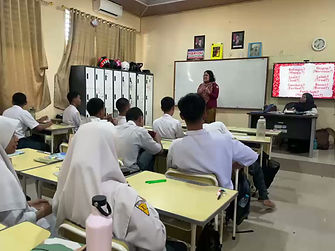
Prior to the class, I greet the learners using appropriate Bahasa Indonesia expressions such as Selamat pagi (good morning), Selamat siang (good afternoon), and Selamat sore (late afternoon). Additionally, as part of my effort to immerse myself in the Islamic school culture, I also greet them with Assalamu’alaikum wa rahmatullahi wa barakatuh, meaning “May the peace, mercy, and blessings of Allah be upon you.” In response, the learners reply in chorus: Wa’alaikumussalam wa rahmatullahi wa barakatuh, which means “And upon you be peace, mercy, and blessings of Allah.”

Afterwards, I ask Nuaim to lead the Doa Belajar (study prayer), a brief supplication (doa) traditionally recited at the beginning of each class, often involving Qur’anic verses for productive and meaningful knowledge acquisition. This is usually delivered in a rhythmic, melodic manner typical of Qur’anic recitation culture (tilawah).


This is followed by a brief emotional check-in, where learners express what they are feeling using American Sign Language (ASL), which I previously introduced to them. I taught them how to sign the question “How are you feeling today?” (Bagaimana perasaanmu hari ini?) and corresponding emotional responses such as bahagia (happy), sedih (sad), gembira (excited), gugup (nervous), lelah (tired), bosan (bored), and patah hati (heartbroken). After this activity, I validate their emotions and remind them that they are worth acknowledging, as emotional awareness is closely tied to effective learning readiness. During an observed Arabic class, I encountered and later adopted a Qur’anic verse often cited in educational and pastoral contexts: "Allah tidak membebani suatu jiwa melebihi kemampuannya" or “Allah does not burden a soul beyond what it can bear.” This verse has since become an anchor in my teaching practice, reminding me to frame adversities as fleeting and surmountable, and to consistently affirm my students’ capacity to navigate and overcome academic difficulties.


Click the right-facing arrow to browse more images.

Click the center of the video to play and the lower-right corner to enable sound.
Afterward, I conduct attendance checking by having the learners say “here” when their names are called and instruct them to place their mobile phones in the designated technology bin. This aligns with the institution’s policy that restricts device usage to teacher-directed activities. Any unauthorized or off-task use results in progressive disciplinary action, ranging from temporary confiscation to longer retrieval periods depending on the severity of the violation.


Click the center of the video to play and the lower-right corner to enable sound.
I then reintroduce the STAR classroom rules, which I co-designed with them and translated to Bahasa Indonesia:
S – Show up ready to learn and participate in class, because learning is a privilege.
Students must recognize that education is an opportunity not everyone has access to; therefore, being present and prepared are the first steps toward success.
T – Try and try until you succeed.
Perseverance is key in learning, especially in science, where curiosity often requires repeated attempts and resilience when faced with adversity. Every seed of adversity carries with it an equal or greater benefit.
A – Always ask questions and seek help, because one who asks may be a fool for a minute, but one who does not will remain a fool forever.
This reminds learners that silence in the face of confusion hinders growth.
R – Remember to be kind to everyone with all the time you have, including yourself—and especially yourself.
Learning can be stressful, so kindness must be at the heart of the classroom. They must allow themselves and one another to make mistakes and collectively learn from them.


Click the right-facing arrow to browse more images.

Click the center of the video to play and the lower-right corner to enable sound.
To further improve the classroom structure, I also implement a hand-signal system (sistem sinyal tangan) co-constructed with the learners:
-
Pointer finger – “I have a question.”
-
Pointer and middle fingers – “I require assistance.”
-
Thumb, pointer, and pinky fingers – “I have a personal emergency that requires me to step outside the room.”
-
“C” shape – “I need to use the comfort room.”
This system was designed in response to the need for a more organized and non-disruptive communication protocol during lessons.
After establishing these routines, I ask the learners to recite the class motto: “Always ready to learn, unlearn, and relearn.”


Click the right-facing arrow to browse more images.


Finally, I communicate the learning objectives to the students in their local language and emphasize that they should be mindful of whether the teaching-learning activities (TLAs) effectively address them.
Click the right-facing arrow to browse more images.
One thing I learned is that “No amount of good instruction will come without effective classroom management” because even the best-planned lessons cannot succeed if the classroom environment is not structured and learning-conducive. What I discovered is that the price you pay for effective classroom management is being patient enough to understand the individual differences of your students—from their interests to their likes and dislikes. Establishing rules and routines for secondary students is effective when they are involved in the rule-making process and are held accountable by their peers since, at this cognitive developmental stage, they favor peer validation more than approval from authority figures.
To implement an effective classroom management, I administered a Student Interest and Preference Questionnaire at the start of my teaching internship. This tool enabled me to better understand my students’ learning styles, motivations, and needs, which subsequently informed my teaching strategies and classroom management approaches.
Student Interest and Preference Questionnaire
Part A: About You
1. What is your name/nickname you would like to be called in class?
2. What subjects or topics do you enjoy the most? Why?
3. What subjects or topics do you find most challenging? Why?
4. What are your hobbies or interests outside of school?
5. What type of activities help you learn best? (e.g., group work, individual work, hands-on experiments, visual aids, direct instruction, games, etc.)
Part B: Likes and Dislikes
6. What do you like most about being in class?
7. What do you dislike or find distracting during class?
8. Do you prefer working in groups or working alone? Explain.
9. What motivates you to do your best in school?
10. What discourages or frustrates you in class?
Part C: Classroom Environment
11. What kind of classroom rules or routines help you focus better?
12. What makes you feel comfortable and respected in class?
13. What kind of rewards or recognition do you appreciate the most? (e.g., praise, small privileges, points, physical rewards)
14. How do you prefer to receive feedback? (e.g., written notes, one-on-one, verbal comments)
15. If you could change one thing about how classes are usually conducted, what would it be?
Afterwards, I consolidated the data about Digital Kelas 11-5 to inform my classroom management strategies—how I can minimize disruptions, what positive reinforcements motivate them the most, how I can employ differentiated instruction, and how I can solicit respect without intimidation or coercion.
Aside from the abovementioned, those that are embedded in the actual teaching-learning process include communicating clear rules and expectations before scientific investigations or gamified activities—which the learners established themselves—and assigning specific tasks during group work to prevent off-task behavior or unequal task distribution. I also implement strategic seating arrangements, such as homologizing the learners for the efficient facilitation of differentiated instruction, and I move around the classroom to prevent misbehavior before it even starts. Moreover, I apply positive reinforcement, usually in the form of verbal compliments; points that learners can immediately use, save, or share with their classmates; or by allowing them time to pursue their interests. In addition, I practice Jacob Kounin’s with-it-ness principle, wherein I employ heightened awareness of everything happening in the classroom and address minor disruptions before they escalate into larger behavioral issues. Finally, after every TLA, I facilitate group reflective reporting through prompts, such as “What went right?”, “What went wrong?”, and “How can they improve their performance next time, and how can I improve their educational experiences moving forward?”
.jpg)
procedure
As a pre-service teacher, I have previously applied several learner-centered pedagogical approaches, one of which is problem-based learning, albeit not in as structured and intentional a manner as what I experienced during my teaching internship. As prescribed by the Kurikulum Merdeka, the design of a science learning experience is expected to follow five interconnected stages: orienting students to the problem, organizing students for learning, guiding individual or group investigations, developing and presenting work results, and evaluating the problem-solving process. Anchored to constructivist principles, this framework positions learners as active knowledge constructors through inquiry, collaboration, and contextualized TLAs. What struck me most during its implementation was how naturally it elicited scientific reasoning and student autonomy, particularly within a hybrid classroom setup where both digital and face-to-face interactions had to be meaningfully combined.


APRIL 21, 2026
During my first teaching assignment, after implementing my pre-established classroom management routine, I immediately introduced a hypothetical scenario in which the learners assumed the role of museum conservators. I presented them with the following prompt: “A rare painting is at risk. The air-conditioning system suddenly stopped working, and sunlight is entering the room. If you do not act fast, the painting may get damaged.” Through this inquiry-driven approach, I attempted to situate scientific concepts within an authentic context. Afterwards, employing scaffolded questioning that elicits higher-order thinking skills, rooted in Lev Vygotsky’s sociocultural theory and the concept of the Zone of Proximal Development (ZPD), I asked the learners the following questions:
1. What do you think will happen to the painting when the room becomes hotter? (Menurutmu apa yang akan terjadi pada lukisan itu ketika ruangan menjadi lebih panas?)
2. Why is heat moving toward the painting? Where is it coming from? (Mengapa panas bergerak menuju lukisan? Dari mana asalnya?)
3. Do you think light from the sun can transfer heat? How? (Menurut kalian, apakah cahaya matahari dapat memindahkan kalor? Bagaimana caranya?)
4. Is temperature the same as heat? (Apakah suhu sama dengan kalor?)
Click the right-facing arrow to browse more images.


Click the center of the video to play and the lower-right corner to enable sound.
Rather than directly providing the answers, I intentionally elicited their prior knowledge and misconceptions first. To reinforce accurate responses while simultaneously correcting misconceptions, I introduced a movement-based experiential teaching-learning activity entitled “Bring Me!”. In this activity, I instructed the students to form a line, proceed outside the classroom, and assemble into the randomized groups I had assigned beforehand. Subsequently, I explained the mechanics of the game: the group that managed to collect the greatest number of objects that absorbed heat or were considered panas (hot) would receive additional points for their upcoming project-based task. Surprisingly, the learners’ competitive nature led to an unprecedented yet highly fruitful outcome—they explored almost the entire campus and returned carrying objects of varying shapes and sizes, including a soccer goal stand, a ladder, chairs, plants, motorcycles, and, my personal favorite, a block of cement splashed with blue paint.


Click the center of the video to play and the lower-right corner to enable sound.
At that moment, I spontaneously decided to utilize the cement block as a form of realia to concretize the abstract distinction between heat (kalor) and temperature (suhu). Through inductive questioning, I discussed that suhu pertains to the measure of an object’s degree of hotness or coldness. I then once again employed scaffolded inquiry by asking: “Let us compare the sun and this cement. Which among the two can be categorized as panas and dingin during the early morning?” Expectedly, the learners responded that the sun possesses a high temperature, whereas the cement has a relatively low temperature. Building upon their responses, I elaborated that this temperature difference facilitated the transfer of energy from the sun toward the cement. I then posed a series of follow-up questions such as: “What do we call the energy that moves from an object of higher temperature to an object of lower temperature?”; “If that is the nature of heat transfer, what direction does heat follow?”; and “Is there direct contact between the sun and the cement? Since there is none, what type of heat transfer is involved?” Through this guided discovery approach, I was able to discuss the concepts of heat (kalor), temperature (suhu), the direction of heat flow, and radiation (radiasi) without relying solely on direct instruction.


Click the center of the video to play and the lower-right corner to enable sound.


Click the right-facing arrow to browse more images.


Upon returning to the classroom, I reinforced these interconnected concepts through a visual concept map that simplified their relationships.
Click the center of the video to play and the lower-right corner to enable sound.
Afterwards, I facilitated a formal discussion regarding thermometers—what defines them, how they are constructed through the thermometric properties of substances, their major classifications, the advantages and disadvantages of mercury and alcohol as thermometric liquids, and their specific types utilized in various contexts. To sustain learner participation, I integrated analogies, contextualized examples, impromptu board illustrations, and collaborative prediction games that elicited their prior knowledge. For instance, during the discussion of the different types of thermometers, I observed that when learners were unable to identify or name a particular device, it signaled the need for me to allocate more instructional time toward elaborating its mechanism and practical application. In this sense, assessment became seamlessly embedded within instruction itself, reflecting the principles of formative assessment and responsive pedagogy.


Click the right-facing arrow to browse more images.
Throughout the discussion, I also consistently practiced informal formative assessment through nonverbal feedback mechanisms. In between concepts and transitions of topics, I would ask the learners to give a thumbs up if they understood the lesson and a thumbs down if they needed further clarification so I could immediately revisit or re-explain the concept before proceeding. Moreover, I remained highly attentive to the classroom hand-signal system, particularly when learners raised their pointer finger to signify that they had a question or wished to contribute to the lecture. Although seemingly simple, these routines enabled me to maintain a learner-sensitive classroom environment.
APRIL 24, 2026
As a continuation of the previous lesson, my second teaching assignment, which spanned three hours, revolved around a project-based laboratory task centered on thermometer construction. Anchored on the principles of project-based learning (PBL) and experiential learning, the activity was designed to allow learners to actively construct scientific knowledge through hands-on investigation. In alignment with the learner-centered orientation of the Kurikulum Merdeka, the laboratory work emphasized collaboration, inquiry, problem-solving, and authentic application of concepts.
The objectives of the aforementioned laboratory work were as follows:
-
Construct a thermometer utilizing readily available materials in the immediate environment;
-
Investigate the relationship between temperature difference and the expansion of liquid as a basis for temperature readings; and
-
Acquire temperature readings from the constructed thermometer using their own numerical scales.
During the last day of my teaching assistantship, I had already communicated the randomized groupings and instructed the learners to bring the materials necessary for the activity, except for the laboratory equipment the school can provide. This anticipatory preparation guaranteed that the instructional time during the laboratory proper would be maximized efficiently.


At the beginning of the session, after re-establishing classroom expectations and laboratory safety protocols, I facilitated a short recall activity regarding heat transfer, temperature, and thermal expansion. To continuously monitor the learners' comprehension, I once again employed informal formative assessment strategies such as the thumbs up–thumbs down feedback system and attentiveness toward the learners’ hand-signal conventions, particularly when they raised their pointer finger to indicate confusion or ask a question. Afterwards, I distributed the laboratory worksheets and oriented the learners regarding the scientific rationale behind each procedure. Rather than merely instructing them to follow directions mechanically, I attempted to situate every step within an inquiry-based framework by consistently asking predictive questions before they performed each procedure.
.jpg)
Click ‘Read More’ to access the document.

The learners then proceeded with the following experimental procedures:
-
Prior to the beginning of the experiment, they utilized scissors or cutters to create a hole in the cap of the plastic bottle. The opening had to be large enough to fit the clear plastic straw.
-
Using rulers and markers, they created their own calibration marks on the plastic straw, which would serve as their improvised temperature scale.
-
With the use of graduated cylinders, they measured 50 mL of water and 50 mL of alcohol.
-
They then transferred the measured liquids into the empty plastic bottle, utilizing glass funnels to prevent spillage.
-
Afterwards, they added three to four drops of food coloring to improve the visibility of the liquid column.
-
The bottle was then sealed with the cap while the plastic straw was inserted through the prepared opening.
-
The straw had to remain submerged in the liquid without touching the bottom of the bottle.
-
To prevent air leakage, the learners secured the cap and straw using modeling clay.
-
They recorded the initial liquid level at room temperature as their baseline reading.
-
Subsequently, the groups prepared two containers: one containing hot water (not boiling) and another containing cold water with ice.
-
The improvised thermometer was then placed in hot water for approximately five to ten minutes while they observed and recorded changes in the liquid level.
-
Afterwards, the thermometer was transferred into cold water for another five to ten minutes, and the corresponding changes were likewise documented.
-
The learners then compared the readings obtained under hot and cold conditions.
-
Finally, they recorded all observations in a data table and answered the guide questions provided.
After completing the experimental setup and observation phase, the learners answered the following guide questions:
-
Apa yang terjadi pada cairan di dalam sedotan ketika Anda memasukkannya ke dalam air panas selama 15 menit?
(What happened to the liquid in the straw when you placed it in hot water for 15 minutes?) -
Apa yang terjadi pada cairan di dalam sedotan ketika Anda mengeluarkannya dari air panas dan memasukkannya ke dalam air dingin setelah 15 menit?
(What happened to the liquid in the straw when you removed it from hot water and placed it in cold water instead after 15 minutes?) -
Apa alasan mengapa cairan di dalam botol naik dan turun jika Anda mengubah pengaturan botol?
(What seems to be the reason why the liquid inside the bottle rises and drops when the setting of the bottle is changed?) -
Di antara dua cairan yang digunakan dalam pembuatan termometer, manakah yang menurut Anda paling bertanggung jawab atas naik dan turunnya cairan tersebut? Mengapa?
(Among the two liquids utilized in the construction of the thermometer, which do you think is most responsible for the rising and dropping of the liquid? Why?) -
Apa kesimpulan yang dapat Anda ambil dari percobaan yang dilakukan?
(What can you conclude from the experiment conducted?)
I deliberately designed the guide questions to progress from simple observation toward higher-order thinking and conceptual generalization, reflecting cognitive progression. During the presentation, rather than immediately validating their answers, I frequently redirected their responses through probing questions such as “What evidence supports your observation?”, “Why do you think the liquid rose?”, and “What relationship can you infer between heat and the movement of particles?”


One of the most fulfilling aspects of the activity was witnessing how the learners gradually realized that scientific instruments such as thermometers are not merely ready-made devices but are themselves applications of scientific principles, particularly thermal expansion. Through this laboratory experience, abstract concepts became more tangible and meaningful to them. Interestingly, not all improvised thermometer setups immediately achieved the intended result. In some groups, the liquid inside the straw did not rise as expected when exposed to heat. Instead of immediately correcting the setup for them, I utilized the situation as an opportunity to cultivate scientific problem-solving and reflective thinking. I guided the learners in determining which aspects of their setup could have affected the outcome, such as possible air leakage or improper sealing of the straw and bottle cap, insufficient submersion of the straw into the liquid, and inaccurate liquid proportions. Through this troubleshooting process, the learners came to realize that scientific investigation inherently involves a cycle of trial, error, and refinement. In numerous ways, the unsuccessful setups became equally valuable learning experiences because they prompted the learners to think critically about variables, procedural accuracy, and experimental reliability. Moreover, beyond conceptual understanding, the activity also cultivated the 4Cs (collaboration, communication, critical thinking, and creativity), all of which are accentuated within 21st-century education frameworks and the Kurikulum Merdeka.

APRIL 28, 2026
My last teaching assignment was my demonstration teaching in a digital Physics class (Kelas 11-5) focusing on the comparison and conversion of temperature scales. Prior to the formal lesson proper, I implemented my usual classroom management routine. To activate the learners' prior knowledge, I facilitated a short review regarding heat, temperature, heat transfer, radiation, and thermal expansion using a random name picker. Specifically, I pose the following recall questions:
1. What is the difference between heat and temperature?
2. What is the direction of heat transfer?
3. How is radiation different from other methods of heat transfer?
4. What is a thermometer and what is its function?
5. Based on our previous experiment, what is the mechanism behind how thermometers work?
Instead of simply validating their answers, I reinforced correct responses, addressed the misconceptions, and provided scaffolded follow-up questions.
As part of the reinforcement process, I even introduced a parody of Katy Perry’s song “Hot n Cold” with corresponding dance steps to help learners retain the concepts more effectively. Surprisingly, the learners became highly engaged with the parody, and some even repeated it during the succeeding activities. At that moment, I realized how music, humor, and novelty can significantly improve concept retention and learner participation.


After introducing the learning objectives, I transitioned toward the Problem-Based Learning (PBL) stages prescribed within the Kurikulum Merdeka. To orient the learners toward the problem, I presented an incomplete comparison table containing the upper and lower fixed points of the four temperature scales. The entries were detachable and intentionally mixed. Working collaboratively, the learners attempted to reconstruct the table using their prior knowledge and logical reasoning. Through this activity, they identified not only what they already knew but also the gaps within their knowledge base. This reflected the constructivist perspective of Jean Piaget, wherein learners actively construct knowledge through interaction and cognitive restructuring. Afterwards, I introduced the temperature conversion formulas and facilitated a short active recall exercise. Rather than promoting rote memorization, I emphasized pattern recognition of proportional relationships among the scales.
The most action-packed portion of the lesson, however, was the game-based activity I designed entitled “Thermal Chaos.” Inspired by the strategic card game 'Exploding Kittens', the activity transformed temperature conversion into an interactive learning task. The class was divided into four groups representing Celsius, Fahrenheit, Kelvin, and Réaumur. Afterwards, I instructed the learners to rearrange the classroom into a 3 × 2 table configuration for the players while the remaining chairs were positioned at the sides for spectators. The game involved various cards such as Thermal Chaos Attack Cards, Insulation Cards, Defuse Cards, and Situation Cards. Learners who were attacked had to solve contextualized temperature conversion problems immediately. Meanwhile, learners who utilized Defuse Cards were required to correctly identify the upper or lower fixed points of their assigned temperature scales. Some special cards, such as Convection Current, Thermal Scanner, and Inversion, introduced strategic mechanics. What fascinated me most was how naturally the learners became immersed in mathematical reasoning and collaborative problem-solving despite initially perceiving temperature conversion as a difficult topic. Throughout the gameplay, whenever a learner solved a conversion problem, they were required to present their solution on the board, explain the formula utilized, and justify their reasoning before the class. Meanwhile, the rest of the learners observed, compared methods, and provided feedback whenever necessary. I validated not only correct answers but also productive mistakes, as I wanted the classroom to become a space where errors were viewed as opportunities for conceptual refinement rather than embarrassment.

Click the center of the video to play and the lower-right corner to enable sound.


Click the right-facing arrow to browse more images.
Another aspect I profoundly appreciated was how the activity unintentionally nurtured the values embedded within the Pancasila Student Profile, particularly cooperation, critical reasoning, independence, creativity, and global diversity. At the end of the lesson, I administered a short formal assessment to evaluate the students' mastery of the covered concepts. Afterwards, I facilitated a reflective discussion through guide questions such as:
1. How do you feel after participating in today’s lesson?
2. What part of the lesson did you find most interesting?
3. What challenges did you encounter while undergoing the teaching-learning activities (TLAs)?
4. What are your expectations for the next lesson?
Their responses revealed that the majority of them previously viewed Physics as intimidating and formula-heavy, but the TLA I employed positively changed their perspective of the subject.
To synthesize the discussion, I revisited the key concepts while clarifying remaining misconceptions. Finally, before dismissal, I introduced the next topic concerning the application of heat and thermodynamics in real-life situations and contemporary issues such as climate change.


Moreover, before I dismissed the class during my first teaching assignment, I demonstrated each procedure step-by-step instead of merely giving verbal instructions. I modeled the proper handling of materials, measurement techniques, assembly of the improvised thermometer, and observation procedures so the learners could visualize the expected process. This approach is rooted in the principles of Albert Bandura’s Social Learning Theory, which emphasizes that learners acquire knowledge and behaviors effectively through observation, imitation, and modeling.
time management and organizing activities
Time management is an integral aspect of the instructional process as it guarantees that specific teaching-learning activities (TLAs) are implemented effectively to achieve the intended learning outcomes (ILOs) within the allotted timeframe. During my international teaching internship, I realized that effective pacing becomes even more significant in learner-centered and inquiry-driven classrooms. At times, I tend to become overly idealistic regarding the number of TLAs I include in a lesson; hence, employing strategies that make these activities feasible within time constraints—or selecting time-bound yet ILO-aligned activities—is necessary for the efficient yet purposeful implementation of the teaching-learning process.
Starting from the lesson planning phase, I divide the instructional period into segments and allocate specific time allotments for each component in minutes. The same principle applies to activities—I communicate the allotted time to the learners and, when necessary, create a visible timeline for the task. For instance, if twenty minutes are allotted for an activity, I indicate progress checkpoints showing where learners should already be at specific intervals so they can self-monitor whether they are progressing at an appropriate pace. To reinforce this, I utilize verbal cues such as, “You have ten minutes remaining to finish your observations,” or “By this time, your group should already be analyzing the results.” I observed that these reminders became particularly beneficial, especially during hands-on experimentation or game-based tasks, where learners tended to become deeply immersed.
Additionally, part of lesson planning involves distinguishing between must-do activities (essential learning experiences) and nice-to-have activities (instructional extensions), with the primary focus remaining on accomplishing the ILOs. For instance, whenever a teaching-learning activity consumes more time than expected, I evaluate which lesson components may be shortened, simplified, or deferred while preserving the lesson’s essential objectives. I also intentionally incorporate buffer time into my lesson plans to accommodate unexpected delays, technological interruptions, extended classroom discussions, or language clarification concerns that naturally emerged within an intercultural classroom context.
During the instructional period, I assign specific collaborative roles to learners to streamline classroom operations and minimize off-task behavior. Leaders ensure that the group remains on-task, recorders document observational data, timekeepers monitor the pacing, material managers handle laboratory apparatus, and reporters present the group’s outputs.
Moreover, I communicate instructions concisely by demonstrating the procedures instead of excessively explaining them verbally. I also post instructions on the board, PowerPoint slides, or worksheets and ask learners to repeat the directions aloud through prompts such as, “Once again, what are we doing first?” Through experience, I realized that modeling procedures significantly minimizes confusion and indecision. I also prepare and organize learning materials beforehand to prevent instructional time from being wasted on distribution or searching for equipment. Furthermore, I prepare exit tickets and quick formative assessments for situations where time becomes limited.
After my teaching assignments, I reflect on which activities consumed more or less time than expected and adjust the pacing and time allocations in subsequent lessons accordingly. Through this reflective practice, I gradually became more realistic in designing learner-centered instruction.

MY NOTES REGARDING THIS ASPECT
problem-solving
For conflict resolution, I employ what I personally coined as the LIGHT Framework. The internship made me realize that encountering behavioral concerns and classroom conflicts is, to some extent, inevitable given the developmental stage, social dynamics, and emotional complexities characteristic of senior high school learners. Adolescents at this age are in the process of forming their identities, seeking autonomy, navigating peer relationships, and managing emotional fluctuations (Erikson's Identity vs. Role Confusion stage); hence, occasional misbehavior, disengagement, excessive competitiveness, side conversations, and resistance to instructions naturally emerge within the learning environment. Rather than perceiving these incidents merely as disciplinary problems, I gradually learned to interpret them as opportunities to be acquainted to my students.
L stands for Look into the issue. The first step is objectively gathering information before reacting—What exactly happened? Who was involved? When and where did it occur? Rather than immediately assigning blame, I focus on understanding the nature and context of the issue. I often reflect on questions such as: “Am I observing reinforced negative behavior, emotional dysregulation, cultural misunderstanding, or an action resulting from an unmet educational need?”
I stands for Identify the root cause. I gather information through observation, quick check-ins, and private conversations with the learners whenever necessary. I ask myself: “What underlying factor is triggering this problem? Is the issue behavioral, motivational, instructional, social, or environmental?” In some instances, I discovered that what initially appeared as disinterest was actually confusion caused by language barriers, fear of making mistakes publicly, or lack of confidence in solving Physics-related tasks.
G stands for Generate actionable solutions. I brainstorm several possible interventions such as adjusting seating arrangements, modifying the lesson pacing, providing positive reinforcement, reframing instructions, or differentiating the task according to learner readiness. The key guiding question for me is: “Which strategy addresses not only the behavior itself but also its underlying cause?”
H stands for Handle it with empathy, because learners respond more positively to restorative practices. Instead of immediately resorting to verbal reprimands, exclusion, or punitive consequences, I acknowledge the situation, help learners understand how their actions affected others, and encourage accountability through reflective dialogue. This may involve apologies, restitution, or demonstrations of changed behavior. Afterwards, I assist them in rebuilding their relationships within the classroom community.
T stands for Test and track the outcomes of the intervention. I document recurring behavioral patterns, successful interventions, and ineffective responses so I can improve my strategies in future situations.
To cite some proactive strategies I consistently apply, the first is positive reinforcement. Verbal praise, participation points, classroom privileges, and logical consequences are applied throughout the instructional process to encourage the repetition of positive behaviors. As much as possible, I prefer redirection over confrontation. I utilize subtle cues and non-verbal signals directed toward the entire class instead of calling out learners individually. I also involve students in the rule-making process and provide them with choices because I observed that granting learners a degree of autonomy often reduces defiance.
On the other hand, to address issues related to conceptual understanding, I conduct quick knowledge checks by directly asking learners whether they understood the lesson through nonverbal feedback mechanisms such as thumbs up if they understood, thumbs sideways if they were partially confused, and thumbs down if they did not understand at all. In some instances, I also utilized paper-based checks whenever I sense that learners are struggling but feel hesitant to admit it openly. Through these formative assessments, I can determine which concepts need to be retaught using a different approach and which learners require remediation or enrichment. Consequently, assessment becomes seamlessly integrated into instruction itself rather than functioning merely as an endpoint of learning.


Sample pages from my reflective journal showing how I utilized the LIGHT Framework during my class observations and assistantships to determine appropriate interventions once I become the main teacher during the succeeding week.

